 By
By Introduction
Simple steps are needed to collect data, but some people may find them hard to understand. Teams often have dashboards, reports, CRM records, gaming trend feeds, and market updates, yet still struggle to answer one simple question: “What should we do next?” At that point, an insights aeonscope becomes a valuable concept.
It describes a layered way to turn raw information into clearer decisions, especially for business intelligence, predictive analytics, tech commentary, and fast-moving digital communities.
The strongest niche for this keyword is business intelligence and data analytics. The gaming and tech commentary angle still matters, but it works best as a secondary use case because the phrase is mainly tied to insight generation, forecasting, dashboards, and decision support.
What Is Insights aeonscope and Why Does It Matter?
Insights aeonscope is a data interpretation approach that connects past patterns, current signals, and likely future outcomes. In simple terms, it helps users move from “what happened?” to “why did it happen?” and “what should we do next?”
This matters because modern teams do not need more random numbers. They need usable intelligence. IBM defines business intelligence as technological processes for collecting, managing, and analyzing organizational data to produce insights that guide strategy and operations.
In a business setting, insights aeonscope can support sales forecasting, customer behavior analysis, risk tracking, inventory planning, and executive reporting. In a gaming or tech media setting, it can help track player sentiment, update cycles, creator trends, game launches, hardware discussions, and community growth.
The key is not the dashboard itself. The value comes from connecting data to a decision.
How Does the insights aeonscope Framework Work?
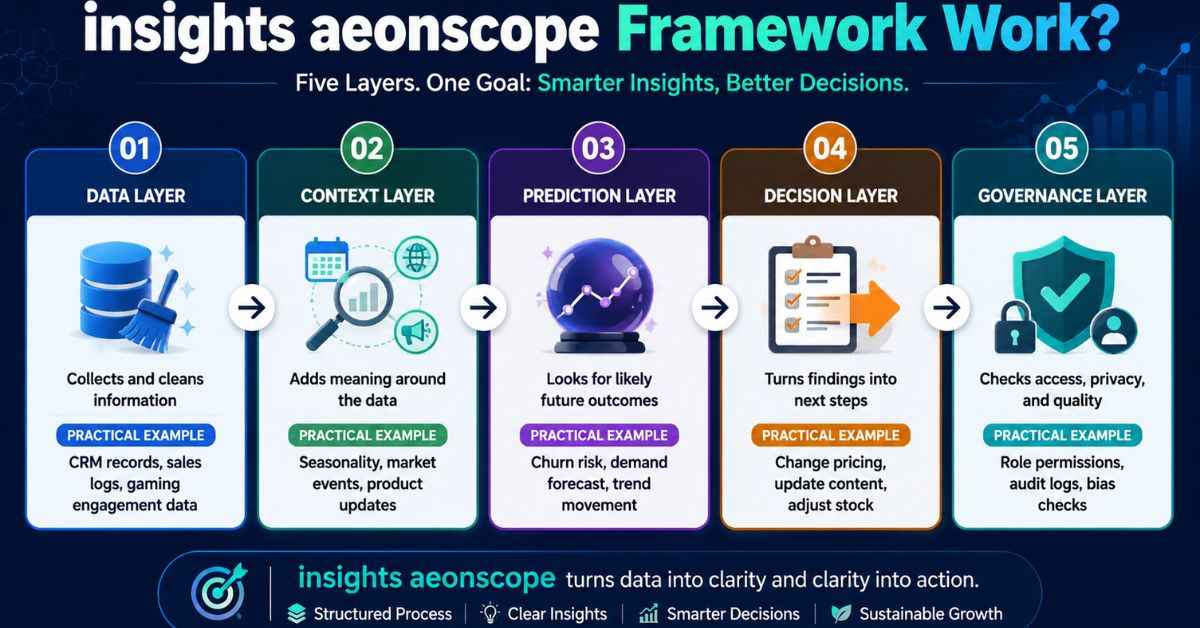
A useful analytics framework needs structure. Without structure, teams may collect data from many tools but never agree on what the numbers mean. The framework can be understood through five layers.
| Layer | What It Does | Practical Example |
| Data layer | Collects and cleans information | CRM records, sales logs, gaming engagement data |
| Context layer | Adds meaning around the data | Seasonality, market events, product updates |
| Prediction layer | Looks for likely future outcomes | Churn risk, demand forecast, trend movement |
| Decision layer | Turns findings into next steps | Change pricing, update content, adjust stock |
| Governance layer | Checks access, privacy, and quality | Role permissions, audit logs, bias checks |
This layered model is useful because each layer answers a different question. Data tells you what exists. Context explains why it may matter. Prediction estimates what could happen. Decisions turn analysis into action. Governance keeps the process responsible.
For example, a retail team may see that sales dropped by 12% in one region. A basic report shows the drop. A stronger framework checks the time period, product availability, competitor promotions, customer reviews, and demand forecast before recommending a response.
Featured Snippet: What Is the Best Way to Use insights aeonscope?
The best way to use this method is to define one decision first, connect the right data sources, analyze patterns over time, and turn the result into a clear business action. It works best when teams combine predictive analytics with human judgment, data quality checks, and simple dashboards.
- Define the decision you need to improve.
- Choose the data sources that directly support that decision.
- Clean the data before building reports.
- Compare historical, current, and predicted trends.
- Turn the finding into a specific action.
- Review the result and improve the model over time.
This process keeps analytics practical. It also prevents teams from building dashboards that look impressive but do not guide real work.
Where Can Businesses and Tech Communities Use It?
Insights aeonscope fits best in situations where decisions depend on changing patterns. That includes business operations, marketing, finance, product teams, and online communities.
Microsoft describes Power BI as a business analytics platform that helps users turn data into actionable insights, connect data, visualize it, and share it across an organization. This shows the broader direction of modern BI tools: less static reporting, more connected decision support.
| Use Case | How It Helps | Example Metric |
| Marketing | Finds which campaigns create quality leads | Conversion rate by source |
| Finance | Spots risk, fraud signals, or cost changes | Unusual transaction pattern |
| Retail | Predicts product demand and stock needs | Sell-through rate |
| Gaming media | Tracks player interest and trend momentum | Patch discussion volume |
| Customer success | Identifies users likely to leave | Churn probability |
For smaller businesses, the framework does not require a massive data team. A small store can start with sales records, customer feedback, website analytics, and email campaign data. The real goal is to ask better questions, not buy the most complex tool.
For gaming and tech commentary sites, the same logic applies. Editors can use trend data to decide which topics deserve deeper coverage. Community managers can study engagement spikes after game updates. Product reviewers can compare reader behavior across hardware, software, and platform news.
Common Mistakes
The first mistake is collecting too much data without a clear purpose. More data does not always mean better insight. Teams should begin with one decision, one audience, and one measurable outcome.
The second mistake is trusting dashboards without checking data quality. If the source data has duplicate records, missing fields, or outdated labels, the dashboard can mislead people quickly.
The third mistake is treating insights aeonscope as a magic tool instead of a working method. Predictive models can support decisions, but they cannot replace human context. A model may detect a trend, but a person still needs to understand customers, timing, budget, and risk.
The fourth mistake is ignoring privacy and governance. NIST says trustworthy AI systems should be valid, reliable, safe, secure, resilient, accountable, transparent, explainable, privacy-enhanced, and fair with harmful bias managed. These ideas matter whenever analytics uses personal, behavioral, or automated decision data.
The fifth mistake is using one dashboard for every team. Executives, marketers, analysts, support agents, and editors need different views. A useful report should match the user’s job.
Pro Tips and Best Practices
Start small. Pick one decision that costs money, wastes time, or creates confusion. Then build your data process around that decision.
Use plain-language dashboard labels. A report is more useful when non-technical readers understand what each chart means.
Review insights weekly or monthly, depending on how fast the data changes. Gaming trends and cybersecurity alerts may need faster review. Long-term finance or inventory planning may need a slower rhythm.
Keep humans in the loop. McKinsey’s 2025 global AI survey found that 88% of respondents said their organizations use AI in at least one business function, but many companies still struggle to scale AI across the enterprise. This makes process design, governance, and team adoption just as important as the tool itself.
Use this framework as a bridge between analysts and decision-makers. Analysts can explain what the data shows. Leaders can explain what action is realistic. Together, they can turn reports into better outcomes.
FAQs
What are insights aeonscope in simple words?
Insights aeonscope is a way to study data across time, context, and likely future outcomes so people can make smarter decisions. It combines business intelligence, predictive analytics, dashboards, and human judgment. The goal is to turn scattered information into clear action.
Is Aeonscope Insights a business intelligence platform?
Aeonscope Insights is commonly described in public articles as a business intelligence and analytics platform, but official product details may vary. Readers should treat third-party claims as starting points, then verify features, pricing, integrations, and security requirements before making a buying decision.
Can small businesses use insights aeonscope?
Yes, small businesses can use this approach by starting with simple data sources such as sales records, website analytics, customer feedback, and campaign results. They do not need enterprise-level systems at first. A focused spreadsheet or basic BI dashboard can still reveal useful patterns.
How is it different from normal analytics?
It is different from normal analytics because it focuses on time, context, prediction, and action together. Basic analytics may show what happened last month. This approach asks why it happened, what may happen next, and which decision should follow.
Does it only apply to business data?
No, it does not only apply to business data. The same idea can support gaming trend analysis, tech commentary, community behavior research, content planning, cybersecurity monitoring, and product feedback tracking. Any field with changing digital signals can benefit from structured interpretation.
What data should a team connect first?
A team should connect the data that supports one important decision first. For sales, that may be CRM and revenue data. For gaming content, it may be engagement, search trends, comments, and release calendars. Clean, relevant data is better than large but messy data.
What is the biggest risk when using predictive analytics?
The biggest risk is acting on predictions without checking data quality, bias, context, and uncertainty. Predictive analytics gives probabilities, not guarantees. Teams should review assumptions, compare model output with real-world knowledge, and avoid using automated recommendations without human oversight.
Conclusion
Insights aeonscope is most useful when readers understand it as a practical decision framework, not just a trendy analytics phrase. Its real value comes from connecting clean data, business context, predictive signals, useful dashboards, and responsible governance.
For businesses, creators, analysts, and tech communities, insights aeonscope can turn scattered information into better choices. The smartest approach is to start small, focus on one decision, test the result, and keep improving the process as new data arrives.