

 By
By Introduction
Running a BPO team is not easy. Managers must balance schedules, service levels, productivity, quality, employee wellness, and client expectations every day. TimeWarp TaskUs is often discussed as a workforce management and productivity platform connected with TaskUs, a global outsourcing company known for customer experience, AI services, trust and safety, and digital operations.
The main question readers ask is simple: what does it do, and why does it matter? This guide explains the platform in plain English, shows how it may support BPO operations, and highlights what employees, managers, and business readers should know before making assumptions.
Why Is TimeWarp TaskUs Important?
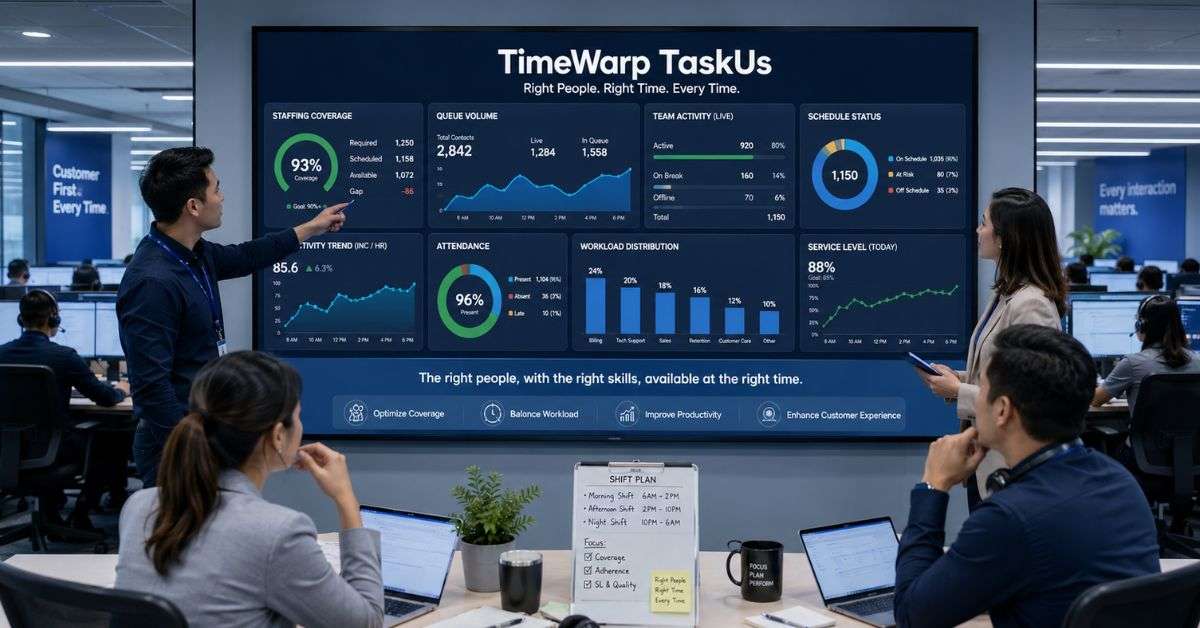
TimeWarp TaskUs can be understood as a specialized internal workforce productivity system used to support TaskUs operations. In simple terms, it helps organize work, track performance signals, improve visibility, and support better planning in a high-volume service environment.
BPO companies handle fast-moving client work. A single team may manage customer chats, content reviews, back-office tasks, AI data work, or trust and safety queues. Without a clear system, managers can lose visibility into workload, staffing, productivity, and service quality.
That is where workforce platforms become useful. They help teams move from guesswork to clearer decisions.
A strong BPO workforce platform may support:
- Time and attendance tracking
- Schedule visibility
- Task allocation
- Productivity dashboards
- Performance reporting
- Quality and compliance checks
- Manager alerts
- Resource planning
The important point is that TimeWarp TaskUs should not be treated like a normal public app unless TaskUs officially provides access. It appears to be connected with internal operations, so login access, features, and user permissions are likely controlled by the company.
How TimeWarp TaskUs Supports BPO Workforce Operations
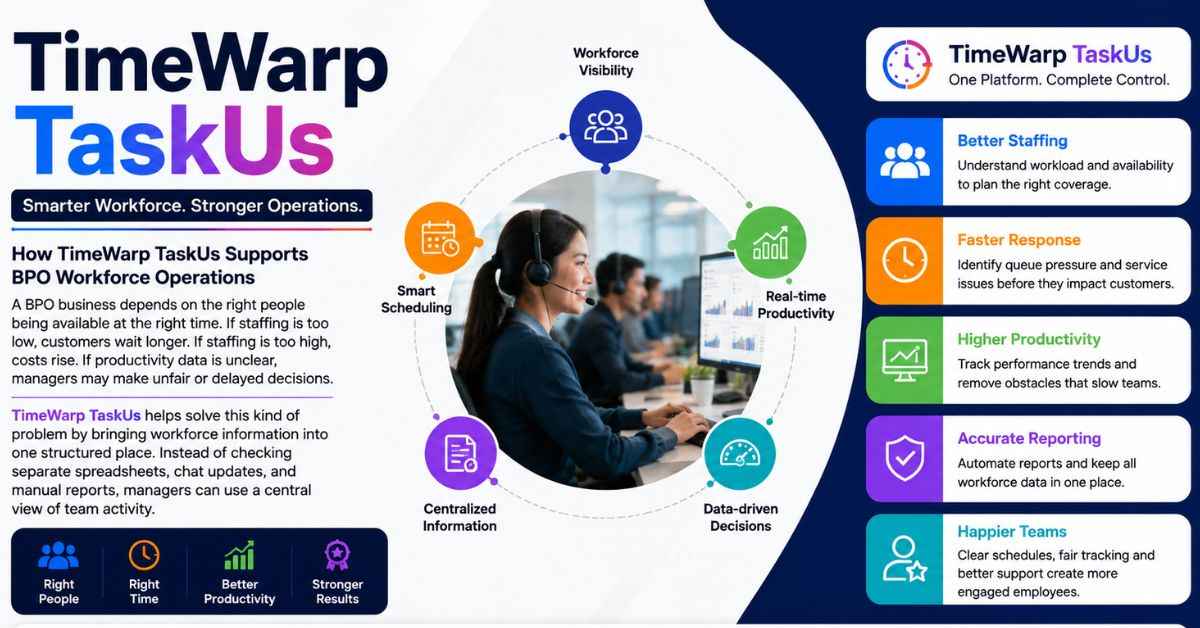
A BPO business depends on the right people being available at the right time. If staffing is too low, customers wait longer. If staffing is too high, costs rise. If productivity data is unclear, managers may make unfair or delayed decisions.
TimeWarp TaskUs helps solve this kind of problem by bringing workforce information into one structured place. Instead of checking separate spreadsheets, chat updates, and manual reports, managers can use a central view of team activity.
Here is a practical example.
Imagine a customer support team receives more chat volume after a product update. Without workforce visibility, the manager may only notice the problem after service levels drop. With a productivity platform, the manager may see higher queue volume, slower response time, and lower staffing coverage earlier.
That allows the team to act faster. They can move trained agents to the busy queue, adjust breaks, request support from another team, or flag the issue to the client.
| BPO Challenge | How a Workforce Platform Helps |
| Unclear staffing needs | Shows workload and staffing gaps |
| Slow response times | Helps managers spot queue pressure |
| Manual reporting | Automates dashboards and summaries |
| Inconsistent schedules | Improves visibility into shifts |
| Low accountability | Tracks work patterns with clearer data |
| Compliance pressure | Keeps records easier to review |
This type of system does not replace people. It gives people better information so they can work with less confusion.
TimeWarp TaskUs Definition, Features, and Practical Use Cases
TimeWarp TaskUs is a workforce management and productivity platform associated with TaskUs operations. It is designed to help organize employee activity, improve operational visibility, and support data-based decisions in BPO teams. Its value comes from connecting people, schedules, tasks, and performance insights in one operational workflow.
That definition matters because many readers confuse productivity platforms with simple time trackers. A real workforce operations system is broader. It connects daily activity with team planning, client goals, and quality expectations.
Key Features Readers Usually Want to Understand
The exact feature set may vary by internal setup, team, region, and role. However, a platform like this commonly supports several important areas.
| Feature Area | What It Means in Real Work |
| Scheduling | Helps teams see shifts, coverage, and availability |
| Productivity tracking | Shows work output, task activity, and performance trends |
| Analytics | Turns raw work data into useful dashboards |
| Task visibility | Helps managers see progress across teams |
| Compliance records | Supports audit trails and policy checks |
| Manager alerts | Flags workload, attendance, or performance issues |
For agents, the platform may create more clarity around schedules and assigned work. For managers, it may reduce time spent collecting reports. For leaders, it may show whether the operation is meeting client goals.
Real-Life Use Case: Managing a Content Moderation Team
A trust and safety team may handle thousands of content review tasks each day. Work volume can change quickly because of news events, platform updates, or user behavior.
A workforce system can show how many tasks are waiting, which teams are active, and where delays are forming. Managers can use this data to reassign work, approve overtime, or adjust staffing for future shifts.
Real-Life Use Case: Supporting AI Data Operations
TaskUs has been growing in AI-related services, where teams may support model training, data review, safety checks, or robotics workflows. These services need consistency, accuracy, and careful quality control.
In that setting, TimeWarp TaskUs can support structured task tracking and team visibility. It can help leaders understand whether teams are meeting deadlines while keeping quality standards in place.
Common Mistakes When Understanding TimeWarp TaskUs
Many online articles make productivity platforms sound simple, but workforce systems need careful explanation. A few mistakes can mislead readers.
The first mistake is assuming the platform is open to everyone. TimeWarp TaskUs appears to be tied to TaskUs internal operations. If someone is not a TaskUs employee, contractor, or authorized user, they should not expect public access.
The second mistake is thinking productivity data tells the whole story. Numbers are useful, but they need context. A low output number may be caused by complex cases, training time, system issues, or unclear instructions.
The third mistake is treating tracking as surveillance. Good workforce management should support fairness, planning, and service quality. It should not create fear or pressure employees with raw metrics alone.
The fourth mistake is ignoring privacy and compliance. Sensitive client, customer, or platform data is frequently handled by BPO teams. Any internal tool must follow access controls, role permissions, and company policies.
The fifth mistake is focusing only on speed. In customer support, content moderation, and AI operations, quality matters as much as volume. Faster work is not helpful if it increases errors.
Pro Tips and Best Practices for Using Workforce Data
A platform is only useful when teams use it wisely. Managers should look at trends, not just single-day numbers. One bad shift does not always mean poor performance.
Use workforce dashboards to ask better questions. Why did time rise? Why did one queue slow down? Why did attendance gaps appear on a certain day? The answers often come from process issues, not only employee behavior.
Here are practical best practices:
- Combine productivity with quality: Track output, but also review accuracy, customer satisfaction, and policy compliance.
- Explain metrics to employees: People work better when they know what is being measured and why.
- Use data for coaching, not only discipline: A dashboard should help managers support people before problems grow.
- Review staffing patterns weekly: BPO demand changes often, so schedules should not stay fixed forever.
- Protect sensitive data: Only authorized users should access employee, client, or customer information.
- Watch for burnout signals: Productivity gains are not sustainable if employees become stressed or overloaded.
For 2026 and beyond, BPO operations will likely keep moving toward AI-assisted workforce planning, real-time analytics, and stronger governance. The best teams will not just collect more data. They will use data with judgment.
FAQs
Is TimeWarp TaskUs available to the public?
No, TimeWarp TaskUs appears to be an internal or company-specific platform, not a public app for general users. Access is likely limited to authorized TaskUs employees, contractors, or approved internal users. For login or account issues, users should follow official TaskUs support channels.
What are TimeWarp TaskUs used for?
TimeWarp TaskUs is used to support workforce productivity, scheduling visibility, task tracking, and operational reporting in a BPO environment. It helps managers understand staffing, workload, and performance patterns. The exact tools available may depend on the user’s role and department.
How does TimeWarp TaskUs help managers?
It helps managers make faster and clearer workforce decisions. A manager can review workload trends, attendance signals, productivity data, and team performance from one place. This reduces manual reporting and helps teams respond before small issues become service problems.
Can TimeWarp TaskUs improve employee experience?
Yes, when applied equitably and openly, it can enhance the work experience. Clear schedules, better task visibility, and timely coaching can reduce confusion. However, managers should avoid using metrics without context because that can hurt trust and morale.
What metrics should BPO teams track?
BPO teams should track productivity, quality, attendance, workload, response time, resolution rate, and employee wellness signals. The best approach is to balance speed with accuracy and customer outcomes. A single metric should never decide the full value of an employee’s work.
Is TimeWarp TaskUs only about time tracking?
No, it should not be viewed as only a time tracker. TimeWarp TaskUs is better understood as part of workforce operations, where scheduling, task visibility, analytics, and performance insights work together. Time data is only one part of the bigger picture.
Why is TimeWarp TaskUs important for BPO operations?
It is important because BPO teams need real-time visibility to manage large and changing workloads. TimeWarp TaskUs can help reduce manual work, improve staffing decisions, support service quality, and give leaders better insight into daily operations.
Conclusion
TimeWarp TaskUs matter because modern BPO work depends on speed, accuracy, fairness, and visibility. A strong workforce platform helps managers understand what is happening across teams, while giving employees clearer structure around schedules, tasks, and expectations.
TimeWarp TaskUs’ true worth extends beyond job tracking. Its value comes from helping people make better decisions with better data. When used responsibly, it can support productivity, quality, employee trust, and stronger client outcomes in a fast-changing outsourcing industry.